


What if the person you’re trusting with your deepest psychological trauma has less medical training than a first-year lifeguard? You’re likely searching for healing because you believe plant medicine offers a profound path to clarity, yet a 2019 report by the ICEERS foundation noted a rise in reports of unethical conduct in unregulated ceremonies. Understanding ayahuasca retreat red flags is the only way to protect yourself from operators who value profit over your well-being. It’s natural to feel anxious about medication interactions or the risk of psychological harm when the industry remains largely unregulated.
You’re going to learn exactly how to vet a center using a data-backed approach to safety. A 2021 study published in the Journal of Psychoactive Drugs found that nearly 70% of participants cited the presence of trained medical staff as their primary safety concern. This article provides a clear checklist to ensure your chosen center meets those high standards. We’ll examine the difference between authentic lineage-based shamans and predatory actors, giving you the confidence to book a journey that’s both spiritually deep and physically secure.
Key Takeaways
- Understand why a lack of rigorous medical and psychological screening is the most dangerous sign of an unsafe healing center.
- Learn to identify common ayahuasca retreat red flags, such as facilitators who claim miracle cures or display a “guru” complex.
- Discover why post-retreat integration is essential for long-term healing and why a lack of aftercare support is a major warning sign.
- Find out how to spot “green flags,” such as comprehensive intake processes and humble guides who prioritize your personal safety and agency.
Beyond the Hype: Why Spotting Red Flags is Essential for Your Healing
Ayahuasca is not a casual spiritual retreat or a standard vacation. It is a deep psychological and physiological intervention. Since the mid-2010s, the explosion of interest in plant medicine has transformed a sacred indigenous practice into a global industry. While this makes the medicine more accessible, it also dilutes the traditional safety protocols that protected seekers for centuries. A 2019 report on psychedelic safety emphasized that most “bad trips” don’t actually come from the medicine itself. Instead, they result from poor screening, lack of preparation, or an unstable environment. You must accept that the vetting process is your responsibility. Identifying ayahuasca retreat red flags before you book is the only way to ensure your healing journey doesn’t turn into a traumatic event.
The Surge in Popularity and the “McAyahuasca” Phenomenon
The commercialization of the Amazonian brew has led to “factory-style” centers that prioritize profit over participant safety. These high-volume locations often host 30 to 40 people per ceremony with only one or two facilitators. When a retreat is priced significantly lower than the regional average, it often indicates corner-cutting in medical staff or psychological support. For foundational Ayahuasca information regarding its traditional use and risks, consulting expert resources is vital. Cheap retreats often lack the overhead for 24/7 medical supervision, which is a major risk factor.
The Vulnerability of the Psychedelic State
During a ceremony, your brain enters a state of extreme neuroplasticity and psychological suggestibility. This makes the “set and setting” non-negotiable. 2021 industry data suggests that centers without a structured integration program see a 15% higher rate of post-ceremony emotional distress. If a center cannot explain its emergency protocols or its method for handling psychological breaks, you’re looking at one of the biggest ayahuasca retreat red flags. A lack of structure doesn’t just hinder healing; it creates a vacuum where re-traumatization can easily occur.
It’s vital to distinguish between a “challenging” journey and an “unsafe” environment. A challenging journey involves facing difficult personal truths or past traumas within a secure container. An unsafe environment is one where your physical or emotional boundaries are ignored. Safe retreats provide a clear ratio of at least one facilitator for every six participants. They also conduct rigorous medical screenings to check for contraindications with SSRIs or heart conditions. If a center skips these steps, they’re gambling with your life. Your safety depends on your ability to look past the marketing and demand transparency from the organizers.
The Most Dangerous Red Flag: Absence of Medical and Psychological Screening
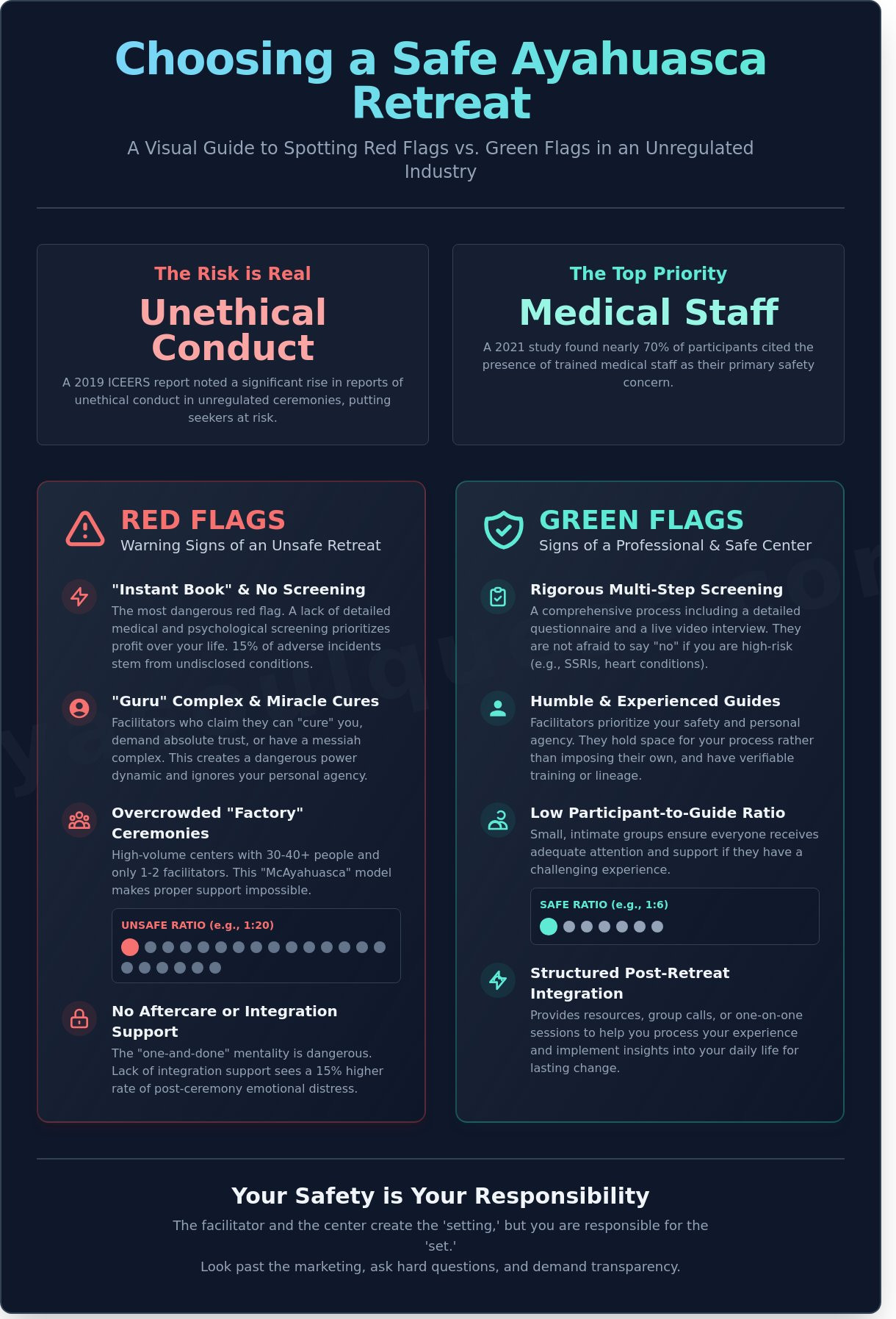
If you see an “instant book” button on a website, it’s one of the biggest ayahuasca retreat red flags you’ll encounter. Legitimate centers treat this medicine with the same gravity as a major surgical procedure. They don’t just take your money and hope for the best. A 2022 report on psychedelic safety highlights that nearly 15% of adverse incidents during ceremonies stem from undisclosed medical conditions or drug interactions. If a center doesn’t ask for your full medical history before accepting a deposit, they’re prioritizing profit over your life.
Rigorous screening is a multi-step process. It usually starts with a detailed digital questionnaire and ends with a face-to-face or video intake interview. This isn’t just a formality. Staff members need to look for specific “red zones” that make the brew a physical or mental liability. You’re looking for a team that isn’t afraid to tell you “no” if your profile suggests a high risk of complications.
Physical Contraindications: When Ayahuasca is Physically Unsafe
Ayahuasca significantly raises blood pressure and heart rate during the peak of the experience. For people with a history of hypertension or heart murmurs, this can lead to cardiovascular distress. A professional retreat center will require a detailed health history and may even ask for a recent EKG if you’re over age 50. They must also check for your use of pharmaceutical drugs. The interaction between the MAOI in the vine and common medications like SSRIs can lead to serotonin syndrome, a potentially fatal condition. Many people don’t realize the dangers of psychedelic retreats that neglect a strict 14-day medication washout period. A medical consultant should always be part of the vetting process to review complex cases.
Psychological Readiness and Pre-Screening
Assessing mental health history is vital to prevent psychotic breaks or severe psychological distress. Screening for conditions like bipolar disorder or schizophrenia is a non-negotiable safety standard. These conditions carry a high risk of drug-induced psychosis when paired with potent tryptamines. A professional intake interview should last at least 25 minutes. During this time, the facilitator determines if you’re experiencing a “spiritual emergency” or a clinical mental illness that requires a different approach. If you’re looking for a center that understands these nuances, it’s helpful to see how safe retreat environments manage their intake protocols. Without this deep dive into your history, you’re essentially walking into a high-stakes lottery with your mental health.
- Warning: Centers that claim ayahuasca “cures everything” without checking your history.
- Essential: A clear list of prohibited medications provided before you book.
- Standard: A required 20 to 30-minute screening call with a trained facilitator.
Evaluating the Guide: Inexperience and the “Miracle Worker” Complex
The facilitator is the most critical factor in your safety during a ceremony. One of the most dangerous ayahuasca retreat red flags is the presence of spiritual narcissism, often called the “Guru complex.” This occurs when a facilitator centers the experience around their own perceived power rather than the safety of the participants. Genuine healers usually describe themselves as humble bridges to the medicine, while those with a complex demand absolute devotion or claim to possess supernatural abilities that others cannot attain.
Be skeptical of any practitioner who guarantees specific medical results. While research from institutions like the Beckley Foundation shows the potential for psychological healing, no ethical guide will promise a 100% cure for stage IV cancer, autoimmune disorders, or deep-seated trauma. If a center uses “guaranteed healing” as a marketing tool, they are prioritizing profit over clinical and spiritual reality. Authentic guides respect the medicine’s unpredictable nature and the participant’s individual journey.
A lack of transparency regarding Indigenous lineage is another warning sign. Traditional training in lineages like the Shipibo or Quehua-Lamista often takes 10 to 15 years of rigorous dieting and study. If a facilitator cannot name their teachers or the specific tradition they follow, they likely lack the depth of experience needed to navigate a spiritual emergency. Respect for Indigenous traditions includes more than just wearing traditional clothing; it requires a documented history of apprenticeship and ongoing reciprocity with those communities.
Facilitator Ratios and Support Staff
Safety is a numbers game. One lead facilitator cannot safely monitor a group of 20 or 30 people in deep altered states. You should look for a minimum ratio of one trained staff member for every 4 or 5 participants. These assistants, or “sitters,” play a vital role in maintaining the “container.” They manage physical needs, such as helping guests to the bathroom or assisting during intense purging, which allows the lead healer to focus on the energetic work. If a center operates with a 1:25 ratio, it is a major safety risk.
Emotional Boundaries and Ethical Conduct
The medicine creates a state of extreme neuroplasticity and emotional vulnerability. This makes the “integration” period particularly sensitive. Reports regarding sexual assault at ayahuasca retreats demonstrate why strict ethical boundaries are non-negotiable. Ethical centers enforce a “no-touch” policy during ceremonies, except for necessary physical assistance, and prohibit any romantic or sexual involvement between staff and guests for at least 6 to 12 months following a retreat.
You can identify a cult-like environment by how the center treats dissent. If the community discourages you from talking to family or suggests that only the “Guru” has the answers to your life’s problems, leave immediately. These are classic ayahuasca retreat red flags that indicate a move toward psychological manipulation. A healthy retreat environment empowers you to return to your daily life with greater autonomy, not a dependency on the facilitator.
Poor Aftercare and the Danger of the “One-and-Done” Mentality
The ceremony ends, the candles are blown out, and you’re suddenly on a plane back to a high-stress job. This abrupt transition is where many participants struggle. One of the most overlooked ayahuasca retreat red flags is the total lack of a structured integration program. True healing happens long after the medicine leaves your system. Many experienced facilitators argue that the ceremony itself is only 50% of the process. The remaining 50% is the difficult work of weaving new insights into your daily habits and relationships.
A dangerous “one-and-done” mentality treats the plant like a clinical magic pill. If a center doesn’t provide a grounding plan, you risk a form of psychological “decompression sickness.” Professional support should include scheduled follow-up calls within the first 14 to 21 days, which is the peak window for neuroplasticity. You should also receive access to a peer community and vetted integration specialists. It’s vital to distinguish between genuine care and sales follow-ups. If the center only contacts you to offer a discount on your next booking, they’re prioritizing profit over your long-term stability.
The Integration Gap: Why Most Retreats Fail Here
Without guidance, participants often fall into spiritual bypassing. This occurs when someone uses the “afterglow” of a ceremony to ignore unresolved emotional wounds or financial responsibilities. A safe center helps you bridge the gap between the visionary state and your 9-to-5 life. They ensure the experience leads to tangible change rather than just a temporary escape. Understanding the nuances of ayahuasca integration is vital for protecting your mental health after the retreat ends.
Transparency in Communication and Logistics
Logistical vagueness is another of the critical ayahuasca retreat red flags. You have a right to know exactly what’s in the brew. Some centers add dangerous additives like Toe (Brugmansia) without informing guests. If a provider cannot name the source of their vine or the specific ingredients in their pot, do not drink. Additionally, ethical retreats share a written emergency protocol. This document should detail the location of the nearest hospital and how the staff manages psychological crises. Be wary of hidden costs or high-pressure sales tactics that demand a deposit before you’ve had a screening call.
Ready to find a center that prioritizes your safety and long-term growth? Explore ethical retreat options and start your journey with professional support.
Choosing with Confidence: The “Green Flags” of a Professional Retreat
Finding a safe space requires looking past polished marketing. While we have discussed several ayahuasca retreat red flags, identifying “green flags” ensures your healing process remains protected. Professionalism starts with a comprehensive intake process. If a retreat asks for your deposit before checking your medical history, walk away. A high-quality center requires a detailed screening of your physical health, mental history, and current medications, such as SSRIs or blood pressure supplements. They value your life more than your bank account.
Seek facilitators who exhibit humility. They should view themselves as guides, not gurus. In a professional setting, the staff prioritizes participant agency. This means you feel empowered to make your own choices during the ceremony without coercion. Group size is another critical metric for safety. Look for retreats that maintain a 1:4 or 1:5 ratio of facilitators to participants. Small groups ensure that if you experience a difficult moment, a trained professional is there to assist you within seconds.
A legitimate experience isn’t just about the ceremony night. It includes a clear, structured path. This typically involves at least 14 days of dietary preparation and a minimum of 21 days of structured integration support after the retreat. This structure prevents the “spiritual bypass” common in lower-quality centers and helps you ground your insights into daily life.
The Green Flag Checklist for Seekers
Verify that the center has a written medical emergency plan. This should include the specific distance to the nearest hospital and on-site safety equipment like oxygen or first aid kits. Authentic testimonials are also vital. Look for reviews that describe the “hard work” or the “challenging moments” rather than just blissful descriptions. Aya Soul Quest implements these ayahuasca safety standards by vetting every participant through a multi-stage screening process. This ensures that the medicine is used responsibly for everyone in the circle.
Trusting Your Intuition After Doing the Research
Data matters, but your gut feeling is the final filter. If you feel pressured, rushed, or ignored during the inquiry phase, those are subtle ayahuasca retreat red flags you shouldn’t ignore. Feeling safe is the most important metric for a successful experience. Schedule a pre-booking call to “vibe check” the organizers. Ask direct questions about their lineage and their specific protocols for psychological emergencies.
If the organizers answer with transparency and patience, you’ve likely found a professional team. Once your research is complete and your intuition settles into a sense of calm, you can finalize your ayahuasca journey with confidence. Taking these steps transforms a risky gamble into a calculated, life-changing investment in your mental and spiritual well-being.
Secure Your Path to Safe Transformation
Identifying ayahuasca retreat red flags protects your mental and physical wellbeing from avoidable risks. Research published in the Journal of Psychoactive Drugs indicates that lack of pre-screening and poor supervision are the most common factors in negative ceremony outcomes. You must look for centers that require a 100% medical disclosure rate and provide at least 4 weeks of structured aftercare. A safe ceremony depends on rigorous safety protocols rather than charismatic promises or miracle worker claims.
Aya Soul Quest prioritizes your safety through a mandatory 3-step medical and psychological screening for every single participant. We maintain small, intimate group sizes to ensure you receive direct, personalized support throughout your entire experience. Every retreat includes a comprehensive integration program designed to help you navigate your post-ceremony life with clarity and purpose. You don’t have to navigate this profound path alone or settle for an environment that skips essential safety steps.
Join a safe, professionally guided retreat with Aya Soul Quest
Your journey toward healing is a sacred investment in yourself, and you deserve a container that respects that depth.
Frequently Asked Questions
Is it a red flag if an ayahuasca retreat is held outside of Peru?
It isn’t necessarily a red flag if a retreat happens outside Peru, but you must verify the local legal status. While Peru recognizes Ayahuasca as national cultural heritage since 2008, countries like the United States only permit its use under specific religious exemptions for the UDV and Santo Daime churches. If a center operates in a country where the brew is illegal, they lack the oversight required for your safety.
How do I know if the shaman or facilitator is legitimate?
Legitimate shamans typically possess a lineage or apprenticeship that lasted at least 10 years under a master teacher. Ask for the specific tradition they follow, such as the Shipibo or Mestizo lineages, and check if they’ve completed 80 or more “dietas” or plant fasts. Ethical facilitators will provide a clear history of their training rather than giving vague answers about being self-taught or “called” by the spirit.
What medications are the biggest red flags for an ayahuasca ceremony?
Selective Serotonin Reuptake Inhibitors (SSRIs) and Monoamine Oxidase Inhibitors (MAOIs) are the most dangerous medications to mix with the brew. Combining these can lead to serotonin syndrome, a condition that’s fatal in 10% of severe cases according to clinical data. Ethical centers require you to be off these medications for at least 5 weeks to ensure the substances have cleared your system before the first ceremony.
Can a retreat center guarantee that I will have a life-changing experience?
No center can guarantee a specific outcome, and making such a promise is one of the major ayahuasca retreat red flags. Psychology research indicates that 20% of participants may experience challenging “dark nights” rather than immediate bliss. Authentic centers focus on preparation and integration instead of using high-pressure sales tactics that promise 100% healing or instant enlightenment after a single week of ceremonies.
What is a safe facilitator-to-participant ratio for a ceremony?
A safe ratio is typically 1 facilitator for every 6 participants to ensure everyone receives adequate attention during difficult moments. If you find a retreat with 30 guests and only 2 staff members, that’s a serious safety concern. Having at least 2 trained helpers present allows one person to assist with bathroom trips while the other monitors the energetic space and handles any physical emergencies.
Is it normal for a retreat to ask for my full medical history?
It’s 100% mandatory for any ethical retreat to conduct a thorough medical screening before accepting your deposit. They should ask about heart conditions, epilepsy, and family history of psychosis or schizophrenia, which affects approximately 1% of the global population. If a center skips this step, they’re ignoring ayahuasca retreat red flags that could lead to life-threatening complications during your stay in the jungle.
What should I do if I notice a red flag after I have already paid?
You should immediately contact the organizers to request a refund based on their stated cancellation policy, which usually offers a full refund if you cancel 30 days in advance. Don’t feel pressured to attend just because you’ve spent 2,000 dollars on a booking. Your physical and mental safety is worth more than the lost deposit, and reputable centers will respect your decision to withdraw if you feel unsafe.
How can I verify the reviews of an ayahuasca retreat center?
Use third-party platforms like RetreatGuru or AyaAdvisors, which host over 5,000 combined reviews, to check for consistent feedback patterns. Look for centers with at least 50 reviews spanning a period of 3 years or more. Don’t trust centers that only show testimonials on their own website, as 90% of these are curated to hide negative experiences or safety complaints from previous guests.