
What if the key to modern psychological healing was perfected by Amazonian tribes over 5,000 years ago, long before the first Western pharmacy opened its doors? You’ve likely heard the intense buzz surrounding this potent brew, but it’s often hard to separate the sensationalist headlines from the sacred reality of the history of ayahuasca. It’s natural to feel skeptical of the sudden hype or confused by the complex web of indigenous traditions that claim this medicine as their own. You want to know if there’s real substance behind the stories or if it’s just another passing trend.
By exploring this guide, you’ll move past the social media noise to understand the multi-millennial journey of the “Vine of the Soul.” You’re going to discover how this hidden jungle tradition evolved into a worldwide catalyst for spiritual growth while gaining a profound respect for the indigenous lineages that protected it. We’ll trace its path from the carbon-dated ritual vessels of 1000 BCE to the 1953 botanical expeditions of Richard Evans Schultes that first introduced the brew to the global stage.
Key Takeaways
- Learn how this “technology of the soul” emerged from the Amazon and why its exact age remains a fascinating mystery.
- Understand the traditional role of the Curandero and how this ancient medicine served as a vital tool for social cohesion and divination.
- Trace the history of ayahuasca through the eyes of early botanists and the cultural shifts that brought it into the Western spotlight.
- Discover the pivotal moments that transformed a hidden jungle ritual into a modern, global wellness phenomenon.
- Explore how honoring ancestral lineages can deepen your personal spiritual journey and ensure the preservation of sacred wisdom.
Tracing the Ancestral Origins: How Old is Ayahuasca?
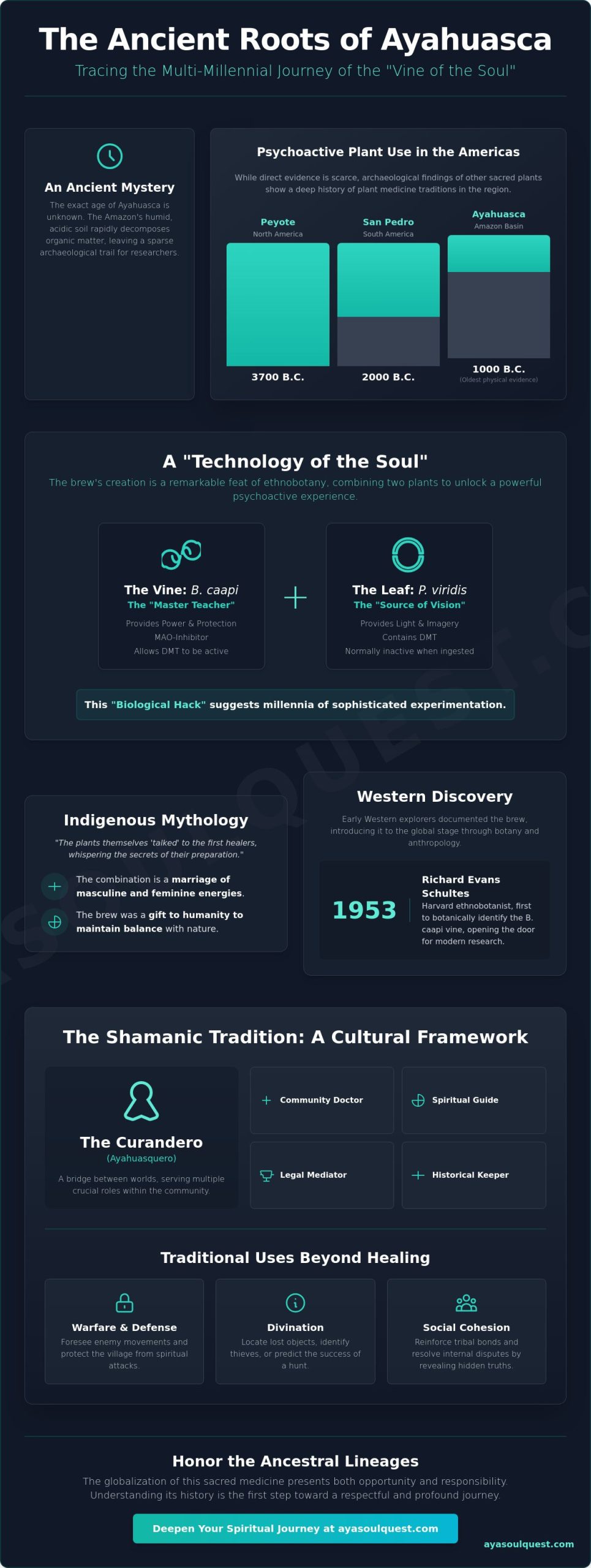
Ayahuasca is far more than a simple botanical beverage; indigenous practitioners describe it as a sophisticated “technology of the soul.” This term reflects the brew’s role as a tool for accessing non-ordinary states of consciousness and ancestral wisdom. Uncovering the exact history of ayahuasca remains a difficult task for modern researchers. The humid, acidic environment of the Amazon basin causes organic materials to decompose rapidly, which leaves a sparse trail for traditional carbon dating methods. While the physical evidence is rare, the chemical complexity of the brew suggests a deep timeline of human experimentation and spiritual practice.
The synergy required to create the drink is remarkable. It involves combining the Banisteriopsis caapi vine with plants containing dimethyltryptamine (DMT), such as Psychotria viridis. Without the vine’s MAO-inhibiting properties, the DMT would be neutralized by the human digestive system. This biological hack indicates that the history of ayahuasca is rooted in an advanced understanding of ethnobotany that predates modern laboratory science by millennia.
The Archaeology of Plant Medicine
Archaeologists have recovered various tools for consuming psychoactive plants across South America, including ornate snuff trays and bone pipe fragments. In 2010, researchers in the Bolivian Andes discovered a ritual bundle containing traces of harmine and DMT dating back 1,000 years. While other sacred plants like San Pedro cactus have a documented use history reaching back to 2000 B.C., and Peyote use in North America dates to 3700 B.C., Ayahuasca represents a more localized but equally ancient tradition. The Chavin de Huantar site established a foundational iconographic language for South American shamanism by integrating feline and serpentine imagery into their sacred architecture.
Indigenous Mythologies of Discovery
The Tukano and Shipibo-Konibo peoples don’t credit their discovery of the brew to random trial and error among the 80,000 plant species in the Amazon. Their oral traditions describe a more mystical origin. The Tukano speak of the “Vine of the Soul” and the “Leaf of Vision” being gifted to humanity to maintain balance with the natural world. Many shamans explain that the plants themselves “talked” to the first healers, whispering the secrets of their preparation.
- The Vine as Teacher: Indigenous groups identify the Banisteriopsis caapi vine as the primary “master” or “teacher” plant that provides the power and protection.
- The Leaf as Vision: The Psychotria viridis leaf is viewed as the source of light and the specific imagery encountered during the experience.
- Spiritual Synergy: The combination of these two elements is seen as a marriage of masculine and feminine energies, essential for a complete healing journey.
These mythologies suggest that the vine’s discovery was an intentional act of communication between humans and the rainforest. By treating the plants as sentient entities, indigenous cultures developed a complex system of medicine that has survived for centuries despite the lack of written records.
The Shamanic Tradition: A Cultural Framework Through the Ages
The history of ayahuasca isn’t just a timeline of plant consumption; it’s the story of the Ayahuasquero, or Curandero, acting as a bridge between worlds. In traditional Amazonian societies, these figures don’t just provide spiritual guidance. They serve as community doctors, legal mediators, and historical keepers. Unlike modern clinical settings where the patient is the primary focus of the medicine, traditional ceremonies often centered on the shaman drinking the brew. This allowed the practitioner to enter a diagnostic state, viewing the patient’s energetic blockages or “virotes” (spiritual darts) to determine the cause of illness.
The medicine’s role extended far beyond individual healing. Historical records and oral traditions show the vine was used for several critical social functions:
- Warfare and Defense: Shamans consumed the brew to foresee enemy movements or protect the village from spiritual attacks.
- Divination: It was a tool to locate lost objects, identify thieves, or predict the success of a hunt.
- Social Cohesion: Ceremonies reinforced tribal bonds and resolved internal disputes by revealing hidden truths.
Central to this practice is the Icaro. These sacred songs aren’t merely music; they’re considered living entities and historical records. Each Icaro represents a specific lineage of teachers and plant spirits, acting as a sonic map that guides the shaman through the visionary landscape. For those looking to understand the depth of these practices, exploring what is ayahuasca? provides a necessary foundation for the cultural nuances involved.
The Shipibo-Konibo Lineage
The Shipibo-Konibo people, traditionally located along the Ucayali River, are renowned for their sophisticated relationship with the medicine. Their culture is defined by “Kené,” intricate geometric patterns that practitioners see during visions. These designs aren’t just aesthetic; they’re a visual representation of the songs (Icaros) and the energetic frequency of the plants. Historically, Shipibo traditions migrated from the deep jungle to more accessible river regions, allowing their unique visionary art to become a primary symbol of the medicine’s visual language.
The Impact of Colonialism and the Rubber Boom
The history of ayahuasca took a dark turn during the 19th-century rubber boom, specifically between 1879 and 1912. This period of intense industrial exploitation forced diverse indigenous groups into shared labor camps. While this era was characterized by suffering, it also forced a cross-pollination of shamanic knowledge as different tribes intermingled for the first time. Despite the efforts of 17th-century Jesuit missionaries and later colonial authorities to suppress these “pagan” rituals, the practice didn’t disappear. It moved underground, becoming a resilient form of cultural identity. This era of prohibition actually helped spread the brew from isolated jungle pockets to the mestizo populations in growing cities like Iquitos. If you feel called to experience this lineage firsthand, you can explore authentic retreat options that honor these historical roots.
The Western Discovery: From Botany to Beatniks
In 1851, British botanist Richard Spruce became the first Westerner to identify the vine Banisteriopsis caapi while traveling through the Rio Negro region of Brazil. Spruce observed the Tukanoan people using the brew, though his collected samples didn’t reach London for full analysis until decades later. This initial contact began a slow shift in the history of ayahuasca, moving the substance from a localized indigenous secret to a subject of botanical curiosity. By the mid-20th century, Richard Evans Schultes, a Harvard biologist, spent 12 years living among Amazonian tribes. He cataloged over 24,000 plant specimens, providing the first rigorous scientific framework for how different tribes prepared and utilized the brew.
The cultural bridge between the jungle and the city was built by the Beat Generation. In 1953, author William S. Burroughs traveled to the Putumayo region of Colombia seeking “yagé” to treat his personal struggles. His correspondence with poet Allen Ginsberg was later published in 1963 as The Yage Letters. These writings didn’t just describe a plant; they framed the Amazon as a site for spiritual and psychological rebirth. This narrative captured the Western zeitgeist, inspiring a wave of seekers to view the rainforest as a destination for profound self-discovery rather than just a source of timber or rubber.
The Rise of Ethnobotany
During his Harvard expeditions, Schultes and his students identified the chemical synergy between the DMT found in Psychotria viridis and the harmine in the caapi vine. This discovery changed the scientific perception of the brew from a primitive “poison” to a sophisticated “psychoactive sacrament.” Schultes’ work in the 1940s laid the foundation for modern research by proving that indigenous botanical knowledge was scientifically precise and pharmacologically complex.
The Emergence of Syncretic Religions
While scientists studied the chemistry, spiritual movements were forming in Brazil. Raimundo Irineu Serra, known as Mestre Irineu, founded Santo Daime in the 1930s, blending folk Catholicism with indigenous traditions. Later, the União do Vegetal (UDV) emerged, formalizing ceremonies for urban populations. These groups were vital in the history of ayahuasca because they secured legal protections. Their structured use of the brew helped establish the legal frameworks that allow for religious use in various countries today.
- 1851: Richard Spruce identifies Banisteriopsis caapi.
- 1930s: Mestre Irineu founds the first Santo Daime community in Acre, Brazil.
- 1953: William S. Burroughs travels to South America, leading to The Yage Letters.
- 1961: The UDV is officially organized by José Gabriel da Costa.
Modern Globalization and the Rise of the Retreat
The 1990s marked a definitive pivot in the history of ayahuasca. Terence McKenna’s 1993 book, True Hallucinations, helped propel the brew from a niche anthropological curiosity into the Western collective consciousness. By the late 1990s, “ayahuasca tourism” began to surge in Iquitos, Peru. What started as an adventurous quest for visionary insight evolved into a structured global wellness movement. Modern retreats now bridge the gap between ancient tradition and contemporary psychological safety; they offer a container for experiences that were once restricted to deep jungle settings.
Critics often ask if this globalization is a form of cultural appropriation. It’s a complex issue. While some commercial entities exploit indigenous symbols for profit, many modern centers work directly with Shipibo or Quechua elders. This ensures that financial benefits return to source communities while preserving the medicine’s sacred roots. Ethical globalization focuses on reciprocity. When Western seekers respect the lineage of the medicine, the history of ayahuasca becomes a shared narrative of global healing rather than one of extraction.
The Shift Toward Healing and Wellness
The focus has shifted from “visionary exploration” to “therapeutic healing.” In the 1970s, Western explorers sought cosmic mysteries. Today, participants seek relief from PTSD, depression, and treatment-resistant addiction. Data from the Global Ayahuasca Project indicates that 85% of users report significant improvements in mental well-being following their ceremonies. This transition emphasizes “Set and Setting,” a concept popularized in the 1960s but refined by modern facilitators to ensure emotional safety in a non-indigenous context. If you’re looking to participate, choosing the right ayahuasca retreat is vital for a safe, integrated experience.
Legal History in the United States and Australia
The legal landscape is defined by the struggle for religious freedom. In 2006, the U.S. Supreme Court ruled in Gonzales v. O Centro Espírita Beneficente União do Vegetal (UDV) that the church could legally use the tea as a sacrament. Similar protections were later extended to Santo Daime branches. In 2020, Oregon’s Measure 109 signaled a broader shift toward plant medicine decriminalization. In Australia, while DMT remains strictly controlled, the Therapeutic Goods Administration (TGA) began allowing limited medicinal use of other psychedelics in 2023. This progress reflects a growing recognition of the medicine’s potential when administered within high standards of safety and professional oversight.
Explore how ancient tradition meets modern safety standards by visiting Aya Soul Quest for more information.
The Future of Ancient Wisdom: Ayasoulquest and Beyond
Understanding the history of ayahuasca isn’t just an academic exercise for scholars. It’s a vital part of your personal preparation. When you drink the brew, you’re participating in a 2,500-year-old technology of the soul. This lineage carries the weight of thousands of ancestral shamans who protected these traditions through colonization and cultural shifts. Respecting this timeline ensures you approach the medicine with the humility it requires. It’s not a recreational experience; it’s a deep dive into an ancient heritage that demands your full presence.
Integration serves as the final chapter of this historical experience. The ceremony doesn’t end when the sun rises. Instead, the history of ayahuasca continues through your actions in the following months. Modern seekers often overlook this, yet it’s the most critical phase for lasting change. You’re not just visiting the past; you’re bringing its wisdom into your future. By connecting your insights to your daily habits, you honor the medicine’s roots while creating a new personal legacy of healing.
Honoring the Tradition in New Mexico and Australia
Ayasoulquest bridges the gap between ancient Amazonian roots and modern safety standards. We operate retreats in New Mexico and Australia, ensuring that every ceremony honors the indigenous lineages from which this medicine emerged. We use 100% sustainably sourced vine and leaf, respecting the delicate ecosystem of the rainforest. Our practitioners often combine these ceremonies with other ancestral tools, such as Kambo Medicine, to provide a holistic approach to physical and spiritual cleansing. This commitment to authenticity ensures that the medicine’s power remains intact even far from the Amazon basin.
Steps to Begin Your Own History
Your journey starts long before you arrive at a retreat. It begins with the Dieta, a traditional practice of abstaining from specific foods and behaviors to purify the body. This isn’t a modern health fad. It’s a centuries-old protocol designed to make you a clear vessel for the spirit of the plants. To begin your own history with this sacred brew, follow these steps:
- Commit to a minimum of 14 days of physical and mental preparation before your retreat.
- Research the lineage of your facilitators to ensure they respect indigenous traditions and safety protocols.
- Focus on your intention rather than the visual sensations to stay grounded in the sacred nature of the work.
We invite you to join a community that prioritizes the sacred over the sensational. If you’re ready to explore how this medicine can inform your healing, contact Ayasoulquest today to learn about our upcoming retreat options across the country.
Embracing the Next Chapter of Your Spiritual Evolution
The history of ayahuasca stretches back over 1,000 years, as evidenced by radiocarbon dating on ritual bundles found in the Lipez Highlands. From Richard Spruce’s first botanical descriptions in 1851 to the beatnik explorations of the 1950s, this medicine has traveled a long road to reach the modern seeker. It’s no longer just a hidden jungle secret; it’s a bridge between ancient traditions and contemporary healing. You don’t have to navigate this path alone or without context.
Ayasoulquest honors these roots by maintaining a deep respect for indigenous Amazonian lineages. We provide a safety-first approach that includes comprehensive integration support, ensuring you’re never left to process these deep experiences in isolation. Our facilitators are rigorously trained in traditional shamanic frameworks to provide the stability you need. Begin your journey with a respectful, lineage-based Ayahuasca retreat today. Your personal transformation is the next meaningful milestone in this ancient story.
Frequently Asked Questions
Is Ayahuasca a drug or a medicine in a historical context?
Historically, indigenous peoples classify Ayahuasca as a sacred medicine and a spiritual tool rather than a recreational drug. They use it for diagnostic purposes and communal healing within the Amazon basin. In the history of ayahuasca, it’s always been treated as a teacher plant that provides wisdom. This perspective differs from Western pharmacological definitions that focus solely on its hallucinogenic properties.
Which indigenous tribes are most closely associated with the history of Ayahuasca?
The Shipibo-Conibo, Tukano, and Asháninka tribes are the primary groups associated with the long-term use of the brew. Anthropologists have documented over 72 distinct indigenous groups in the Amazon that incorporate the tea into their cultural identity. These tribes have maintained specific ritual protocols for centuries, ensuring the traditions pass down through generations of healers called curanderos.
When was Ayahuasca first discovered by Western scientists?
British botanist Richard Spruce first documented Ayahuasca for the Western scientific community in 1851. He observed the Tukano people in the Rio Uaupés region of Brazil using the Banisteriopsis caapi vine. Spruce collected samples for the Royal Botanic Gardens at Kew, though the chemical properties of the plants weren’t fully understood by scientists until the mid-20th century.
Has the recipe for Ayahuasca changed over the last thousand years?
The fundamental recipe of Ayahuasca hasn’t changed significantly in over 1,000 years. A 2019 chemical analysis of a shamanic bundle found in the Bolivian Andes, dating back to 1000 AD, contained traces of the same alkaloids found in modern brews. While some shamans add secondary plants like Diplopterys cabrerana, the core combination of a MAO inhibitor and a DMT source remains the standard in the history of ayahuasca.
What is the history of the legal status of Ayahuasca in the United States?
The legal status of Ayahuasca in the United States shifted in 2006 following a landmark Supreme Court case. The court ruled in favor of the O Centro Espírita Beneficente União do Vegetal, granting them a religious exemption to use the tea. Since then, the Santo Daime church also received similar protections in 2009, though the brew remains a Schedule I substance for non-religious use.
How did the ancient shamans learn to combine two specific plants out of 80,000 Amazonian species?
Indigenous shamans state they learned to combine these two plants through direct communication with the spirits of the forest. Scientists find this remarkable because there are approximately 80,000 plant species in the Amazon. The odds of randomly pairing the Banisteriopsis caapi vine with Psychotria viridis leaves to create a bioavailable psychedelic are astronomically low, suggesting a deep, experiential knowledge of botany.
Is the modern Ayahuasca retreat experience authentic to its history?
Modern retreats vary in authenticity, but many still center their ceremonies on the history of ayahuasca and traditional Shipibo lineages. Around 85% of reputable centers employ indigenous shamans to lead the rituals and sing traditional icaros. While these centers often add modern amenities like electricity or medical screening, the spiritual framework usually mirrors the ancient practices found in the Peruvian Amazon.
What role did the rubber boom play in the spread of Ayahuasca?
The Amazonian rubber boom from 1879 to 1912 was a major catalyst for the spread of Ayahuasca beyond isolated tribes. As rubber barons forced thousands of indigenous people from different regions to work together, their diverse shamanic traditions merged. This period of forced migration and cultural exchange allowed the brew to reach mestizo populations and eventually move into urban areas like Iquitos.