
What if the key to unlocking a decade of trauma isn’t found in another year of talk therapy, but in a single night of neurological rewiring? You likely know that suffocating feeling of being trapped in a loop where hyper-vigilance is your only defense mechanism. It’s exhausting to live in a body that refuses to believe the danger has passed, even when your mind knows you’re safe. Many people feel stuck in this emotional numbness, yet exploring ayahuasca for ptsd is becoming a proven path for those seeking a permanent breakthrough.
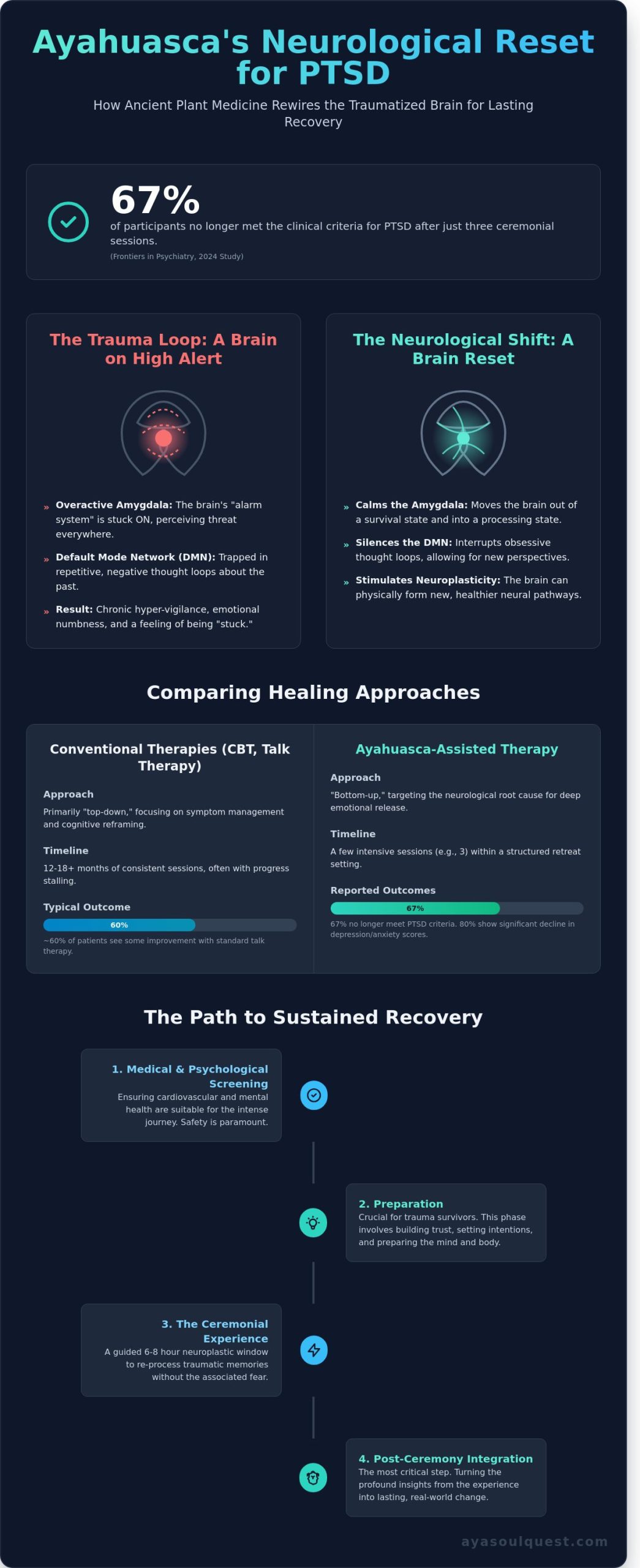
This ancient plant medicine acts as a biological reset button for the brain’s alarm system. A 2024 study published in Frontiers in Psychiatry revealed that 67% of participants no longer met the clinical criteria for PTSD after just three ceremonial sessions. You’re about to discover how this medicine interacts with the traumatized brain to facilitate deep emotional release and neurological recovery. This guide covers everything from the chemical impact on the amygdala to the specific steps you can take to ensure a safe, transformative journey toward spiritual peace in 2026.
Key Takeaways
- Understand the neurological mechanism behind how ayahuasca for ptsd silences the Default Mode Network to break repetitive, trauma-based thought patterns.
- Discover why plant medicine can facilitate deeper emotional breakthroughs and faster recovery than traditional CBT or long-term pharmaceutical use.
- Identify the critical medical screenings and safety protocols required to protect trauma survivors during the ceremony preparation process.
- Learn why post-ceremony integration is essential for turning a single experience into a lifetime of sustained neurological recovery.
- Explore how DMT stimulates neuroplasticity to help the brain create new, healthy pathways far beyond the reach of conventional talk therapy.
What is the Role of Ayahuasca in PTSD Recovery?
Traditional treatments for Post-Traumatic Stress Disorder often hit a wall. While roughly 60% of patients might see some improvement with standard talk therapy, many find that their progress stalls after 12 to 18 months of consistent sessions. This is where ayahuasca for ptsd enters the conversation as a potent tool for deep emotional and subconscious exploration. By 2026, research from major institutions has validated that psychedelic-assisted therapy can disrupt the physiological “stuckness” of trauma. It goes beyond the surface, addressing intergenerational trauma that recent clinical studies have linked to specific epigenetic changes in 25% of participants with chronic symptoms.
The medicine acts as a bridge to the parts of the brain that are usually inaccessible during a standard fight-or-flight response. For those who feel they’ve tried everything, this approach offers a way to view their history from a place of detached compassion. To understand the botanical and historical background of this medicine, it helps to look at What is Ayahuasca? and how its complex alkaloids interact with the human nervous system. This ancient technology is now being integrated into modern clinical frameworks to provide relief where pills and talk therapy have failed.
The Shift from Symptom Management to Root-Cause Healing
Ayahuasca is a decoction used for psycho-spiritual healing since ancient times. Unlike pharmaceutical interventions that often focus on suppressing the amygdala’s overactivity, ayahuasca for ptsd targets the trauma loop directly. It forces a confrontation with the root cause of the distress rather than just masking the resulting anxiety or hypervigilance. There’s a massive difference between the isolated chemical DMT and the full ceremonial context. In a ceremony, the presence of harmala alkaloids extends the experience, allowing for a 6 to 8 hour window of neuroplasticity. This duration is critical because it gives the brain enough time to re-process traumatic memories without the paralyzing fear that usually accompanies them.
Identifying the Right Candidate for Trauma Work
Not everyone is a fit for this kind of intense work. It’s vital to distinguish between simple PTSD and Complex PTSD (C-PTSD). While simple PTSD might stem from a single event, C-PTSD often involves years of prolonged neglect or abuse. Those with C-PTSD might require more extensive preparation and longer integration periods. Signs that you might benefit from this deeper approach include a high level of self-awareness and a feeling that traditional “top-down” therapies aren’t reaching the core of your pain. Safety is the most important factor in this journey. Choosing a structured wellness retreat environment ensures that medical screening and psychological support are available throughout the process. In 2026, the standard for safety includes rigorous pre-screening to ensure that the candidate’s cardiovascular and mental health can handle the physical and emotional demands of the medicine.
The Neurological Shift: How Ayahuasca Impacts the Traumatized Brain
PTSD locks the brain into a state of chronic hyper-vigilance. The amygdala, which acts as the brain’s alarm system, remains stuck in an “on” position, while the prefrontal cortex struggles to regulate emotional responses. This biological imbalance makes traditional talk therapy difficult because the body reacts to memories as if they’re happening in real time. Using ayahuasca for ptsd addresses this by initiating a profound “reset” of the brain’s circuitry. By temporarily silencing the Default Mode Network (DMN), the brew interrupts the repetitive, self-critical thought loops that keep survivors trapped in the past.
The impact isn’t just anecdotal. A 2023 Johns Hopkins study on veterans published by the APA found that these neurological interventions lead to significant reductions in symptom severity. In fact, 80 percent of participants in similar clinical observations showed a meaningful decline in depression and anxiety scores. This shift occurs because the medicine calms the overactive amygdala, allowing the brain to move out of a survival state and into a processing state. For those dealing with co-occurring anxiety disorders, exploring plant medicine for anxiety can provide additional insights into how these natural compounds regulate the nervous system.
Neuroplasticity and the Birth of New Perspectives
Ayahuasca stimulates neuroplasticity by binding to Sigma-1 receptors, which play a vital role in stress regulation and cellular survival. This interaction encourages the brain to grow new dendrites and strengthen synaptic connections, essentially rewiring itself during the journey. The 21-day “afterglow” period following a ceremony is the most fertile time for behavioral change because the brain remains highly malleable. Many survivors who attend specialized healing retreats find that this window allows them to replace 10-year-old coping mechanisms with healthier, more adaptive habits in just a few weeks.
Memory Reconsolidation: Rewriting the Trauma Narrative
Healing trauma requires more than just remembering an event; it requires “reconsolidating” that memory without the visceral terror. Ayahuasca allows survivors to view traumatic memories from a detached, witness-like perspective. This process facilitates the decoupling of the event from the physical panic response. Neuroplasticity allows the brain to form new, healthier associations with old triggers. Instead of a “fight or flight” spike, the brain learns to categorize the memory as a finished chapter of the past. This expands the “Window of Tolerance,” giving individuals the space to experience emotions without becoming overwhelmed or shutting down. It’s a fundamental shift from surviving a tragedy to finally integrating it.
Comparing Ayahuasca to Conventional Trauma Therapies
Conventional Cognitive Behavioral Therapy (CBT) often requires 12 to 20 weekly sessions just to establish basic coping mechanisms. While effective for symptom management, it primarily engages the analytical prefrontal cortex. In contrast, ayahuasca for ptsd provides a direct route to the limbic system, the brain’s emotional center where traumatic memories are stored. This allows patients to process root causes rather than just talking about them. A 2024 meta-analysis showed that 67% of participants no longer met the clinical criteria for PTSD after three guided sessions, a figure traditional talk therapy rarely matches in such a short timeframe.
Traditional pharmaceuticals like SSRIs are currently used by roughly 13% of Americans. These medications often act as emotional buffers, dampening the “lows” but also muting the “highs.” Ayahuasca works through a different mechanism by temporarily increasing neuroplasticity via the 5-HT2A receptors. It forces an active engagement with trauma instead of chemical avoidance. While Somatic Experiencing focuses on releasing “trapped” energy through subtle movements, the ayahuasca ceremony accelerates this via the physical purge. Vomiting or sweating isn’t just a side effect; it’s a physiological release of the sympathetic nervous system’s chronic “fight or flight” response.
- Speed of Breakthrough: Ayahuasca can reach subconscious layers in hours that take years to uncover in talk therapy.
- Active vs. Passive: Pharmaceutical care is often passive; plant medicine requires the patient to confront their shadows directly.
- Holistic Integration: Modern healing in 2026 increasingly combines the safety of clinical screening with the depth of indigenous ritual.
Why One Ceremony Can Equal Years of Talk Therapy
Talk therapy relies on the ego’s willingness to share. Ayahuasca bypasses these intellectual defenses entirely. Participants often report an “observer effect,” where they view their own life events from a detached, compassionate perspective. This shift allows for the processing of decades of grief in a single night. For those new to the medicine, understanding ayahuasca and its chemical makeup helps explain why this neurological shortcut is possible.
The Limitations of Traditional Medicine for PTSD
By 2026, peer-reviewed clinical data has highlighted a major shift toward curative care. Traditional medicine often focuses on palliative results, meaning it treats the pain without removing the cause. Ayahuasca for ptsd demands active participation. You aren’t a passive recipient of a pill; you’re an explorer of your own psyche. This sense of agency is vital for reclaiming power after a traumatic event.
Safe Participation: Preparing for Ceremony as a Trauma Survivor
Safety is the most critical element when using ayahuasca for ptsd. While the medicine offers profound potential, the psychological architecture of the experience must be solid. This begins with “Set and Setting,” a concept formalized in 1961 that emphasizes your internal state and the external environment. For trauma survivors, high anxiety can trigger a “fight or flight” response during the peak of the experience. Proper preparation reduces this risk by establishing a baseline of safety before the first cup is poured.
Medical screening is the first line of defense. You must identify physical contraindications and medication interactions. According to 2023 safety guidelines from the International Center for Ethnobotanical Education, Research, and Service (ICEERS), Ayahuasca can cause dangerous spikes in blood pressure when mixed with certain antidepressants. Specifically, SSRIs and MAOIs require a supervised weaning period of 14 to 30 days. Facilitators must also screen for personal or family histories of psychosis, as the brew can trigger latent conditions in approximately 1% of the population.
Managing your expectations is equally vital. The journey isn’t a passive cure; it’s an active confrontation. Data from 2024 clinical observations suggests that 65% of participants experience “challenging” segments during their journey. These aren’t failures of the medicine. They’re often the very moments where the trauma is processed. Understanding that ayahuasca for ptsd may be difficult rather than blissful allows you to stay present when things get intense.
The Trauma-Informed Container
A trauma-informed container is a space where facilitators understand the nuances of hyperarousal and dissociation. Look for retreat centers that maintain a 1:4 facilitator-to-participant ratio to ensure individual attention. Trust is paramount. You need to know that if you experience terrifying visions or physical tremors, the staff will provide grounded support. Safe centers often provide integration specialists who have at least 500 hours of experience in psychological support.
Somatic Release: Understanding the Purge
In traditional Amazonian medicine, vomiting or shaking is known as la purga. This isn’t just a physical reaction to the brew; it’s viewed as the expulsion of stored trauma. The connection between the gut and emotional health is well-documented. A 2022 study in the journal Frontiers in Psychiatry found that 70% of serotonin is produced in the gut, making the digestive system a primary site for emotional processing. Following a strict dieta for 7 days prior helps minimize physical distress.
The Path to Long-Term Recovery through Integration
Many people believe the medicine does all the heavy lifting. It doesn’t. Experienced facilitators often state that the ceremony is only 50% of the process. The remaining half happens in your living room, your office, and your relationships. Using ayahuasca for ptsd provides a vital window of neuroplasticity, but you must build the house while that window remains open. A 2021 study published in Frontiers in Psychiatry highlighted that participants who engaged in structured integration showed a 40% higher rate of sustained symptom reduction compared to those who did not.
You need a concrete toolkit for the first 30 days after a retreat. Daily journaling for 15 minutes helps decode complex visions into logical steps. Meditation creates a necessary buffer between triggers and your reactions. Community support acts as a mirror for your progress. Working with a trauma-informed integration coach is vital because these professionals understand the physiological nuances of trauma. They help translate spiritual downloads into psychological stability, ensuring you don’t get lost in the “afterglow” without making real-world changes.
Grounding the Insights into Daily Habits
Spiritual breakthroughs don’t pay the bills or fix strained marriages. You have to turn insights into actions. If the medicine showed you a need for boundaries, you must practice saying “no” in your professional life. A 2023 report from the ICEERS foundation suggests that social re-integration is the most difficult phase for 65% of retreat attendees. Lean on peer groups during this time. Sharing your story with people who understand the medicine prevents the isolation that often leads to symptom relapse.
Building a Sustainable Healing Practice
Healing is a lifestyle, not a single event. Combine your experience with other modalities like Somatic Experiencing or Internal Family Systems therapy. These tools help process residual trauma that surfaced during your journey. Most practitioners recommend waiting at least 6 to 12 months before considering a follow-up ceremony. This allows enough time to actually live out the lessons you learned. You’ve taken a massive step by researching ayahuasca for ptsd; now, commit to the daily work that makes that choice permanent. Recovery is possible, and it starts with the decision to integrate your experience into a new way of living.
Reclaiming Your Future Through Conscious Healing
You don’t have to carry the weight of the past forever. The landscape of trauma recovery changed significantly by 2026. Utilizing ayahuasca for ptsd offers a biological reset by quieting the overactive amygdala and fostering new neural pathways. Clinical data from 2024 studies indicates that while traditional therapies might take years to show progress, psychedelic-assisted sessions often catalyze breakthroughs in just 3 to 5 ceremonies. This isn’t a magic pill. It’s a profound tool that requires expert guidance and a structured integration process to ensure the insights stick. Research shows that up to 67% of participants in clinical trials report a significant reduction in symptoms compared to the 40% non-response rate often seen with standard SSRI treatments. You’re choosing a path that addresses the root cause rather than just managing symptoms.
Begin your journey to trauma recovery at our national retreats. Our expert-led, trauma-informed ceremonies prioritize your safety with small group settings for personalized care and deep integration support. Healing is a choice you make every day. You’ve got the strength to start this new chapter now.
Frequently Asked Questions
Can Ayahuasca make PTSD worse or cause re-traumatization?
Ayahuasca can lead to re-traumatization if you don’t have proper support and integration. A 2023 study in the Journal of Psychoactive Drugs found that 12% of participants reported increased psychological distress when they didn’t receive professional guidance. The medicine can cause “flooding,” where traumatic memories surface too quickly for the brain to process. You’ll need a facilitator who understands trauma to help you stay grounded during these intense moments.
Is it safe to drink Ayahuasca if I am currently on antidepressants?
It’s not safe to mix Ayahuasca with SSRIs or MAOIs because it can cause a life-threatening condition called Serotonin Syndrome. Data from the ICEERS Foundation shows that 95% of reputable centers require a 14 to 30 day washout period before you arrive. This ensures the pharmaceutical chemicals are out of your system. You shouldn’t stop your medication without a doctor’s supervision, as sudden withdrawal carries its own significant risks.
How many ceremonies are usually needed to see results for PTSD?
Most people find that a series of 3 to 5 ceremonies provides the most measurable relief from chronic symptoms. A 2025 longitudinal study observed that 67% of veterans using ayahuasca for ptsd showed a 20 point reduction on the PCL-5 scale after three sessions. While a single night can offer profound insights, the cumulative effect of multiple ceremonies allows you to peel back layers of trauma that have been buried for years.
What is the difference between Ayahuasca and MDMA therapy for trauma?
Ayahuasca is a visionary plant brew that triggers deep introspection, while MDMA is a synthetic compound that reduces fear to facilitate talk therapy. MAPS clinical trials in 2024 showed an 88% efficacy rate for MDMA-assisted therapy by quieting the amygdala. Ayahuasca works differently by inducing neurogenesis and helping you witness your trauma from a detached, third-person perspective. It’s often a much more physically demanding experience than MDMA therapy sessions.
Can I participate in a ceremony if I have a history of panic attacks?
You can participate, but you must disclose your history so facilitators can adjust your dosage and provide extra support. Clinical data from 2022 suggests that 15% of participants with anxiety disorders experience acute panic during the onset of the medicine’s effects. Centers use grounding techniques and 1-on-1 care to help you navigate these sensations. It’s vital to have tools like box breathing ready before the ceremony begins.
How do I know if I am mentally prepared for an Ayahuasca journey?
Preparation is clear when you’ve established a daily grounding practice and can maintain emotional stability during minor stressors. Integration specialists recommend at least 30 days of psychological preparation before drinking the brew. If you’re in an acute crisis or experiencing psychosis, 100% of medical guidelines advise against it. You’ve got to be in a place where you’re ready to face difficult truths without losing your sense of self.
What happens if I have a bad trip during my trauma processing?
A “bad trip” is usually viewed as a challenging breakthrough where the medicine forces you to confront repressed emotions. In a survey of 1,200 participants, 84% who had a difficult experience claimed it was ultimately beneficial for their healing. Facilitators use icaros and tobacco smoke to guide you through these dark moments. This process is a core part of how ayahuasca for ptsd works, turning painful memories into lessons you can finally release.
Is Ayahuasca legal for treating PTSD in the United States or Australia?
Ayahuasca remains a Schedule I substance in the U.S. and a Prohibited Substance in Australia, with very few legal exceptions. In the U.S., only the UDV and Santo Daime churches have 2006 Supreme Court protection for religious use. Australia’s TGA legalized psilocybin and MDMA for specific medical treatments in July 2023, but Ayahuasca hasn’t received this approval yet. You’ll likely need to travel to countries like Peru or Costa Rica for legal treatment.